About
Michael Kimelman
Lawyer. Trader. Fund founder. Defendant. Author. The résumé is unusual on purpose — it is the reason the training works.
About me
- Associate at Sullivan & Cromwell in the Mergers & Acquisitions practice.
- Top-ranked portfolio manager at several hedge funds and proprietary trading firms; consistently delivered market-beating alpha with an abnormally low volatility profile.
- Founder and president of the multi-strategy hedge fund Incremental Capital. At its peak, Incremental managed over $250M in assets with 50 employees and outstanding risk-adjusted returns.
- Lafayette College, B.A. 1993. University of Southern California Law School, J.D. 1996, Law Review.
- Turned down a plea offer to one count of conspiracy and a sentence of probation.
- Convicted at trial of one count of conspiracy and one count of insider trading (3Com) in a highly controversial trial at the height of Occupy Wall Street, before Judge Richard Sullivan — the jurist later reprimanded and overruled by the Second Circuit in the Newman, Chiasson and Steinberg cases, among others.
- Formerly incarcerated at Lewisburg Federal Prison for 15 months, and a Bronx residential re-entry program for six months.
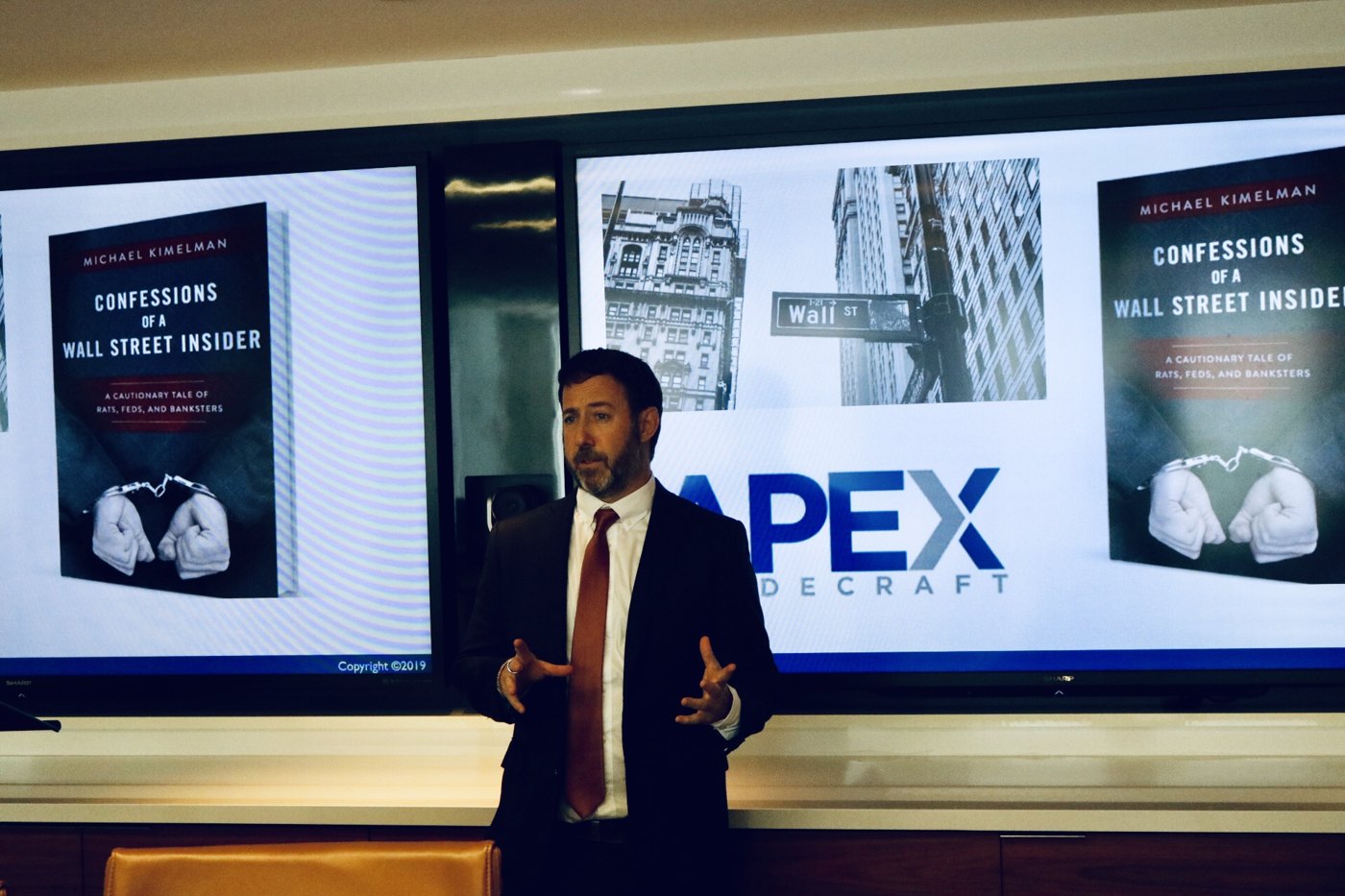
- Bestselling author of Confessions of a Wall Street Insider: A Cautionary Tale of Rats, Feds & Banksters (Skyhorse Publishing).
- Recognized consultant, writer and speaker in the field of insider-trading compliance and ethics, focused on the critical real-world issues facing hedge fund and broker-dealer principals, traders and compliance personnel.
- Former lawyer, Chartered Financial Analyst, and holder of Series 7, 63 and 55 licenses.
- Consultant to the Showtime series Billions; documentary producer and writer; featured in a CNBC documentary alongside Dennis Kozlowski, Joe Nacchio and Bernard Kerik.
- Managing Partner, Dekryption Ventures — strategic advisory and investment in frontier technology and life sciences.
My story
One trade. And it still destroyed my life.
When you decided to pick up this book, chances are the one thing you knew about me was that I'm a convicted felon.
In America, we're careful to repeat the adage that someone charged with a crime is innocent until proven guilty. But let's be honest. Let's be frank. This is you and me talking here. Most of the time, when someone is indicted and brought to trial for a financial crime, we assume that he (or she, but usually he) is likely to have done something wrong. And if that defendant is found guilty by a jury of his peers? Then the assumption becomes an accepted fact. The jury heard all the facts and made an educated pronouncement. The system worked.
Or did it?
It was alleged that on August 8 of 2007, I bought shares of stock in a company called 3Com six weeks before a large takeover deal for that company was announced. It was further alleged that I bought this stock because I had illegal information about the trade. When I was arrested, it was along with several other traders from more than one firm. Some of these men — when convicted — would see prison terms that set new records for sentences given in insider trading cases. These men were charged with making multiple illegal trades and perpetrating a vast conspiracy of illegal insider information.
I was, again, charged with making one illegal trade. (And, later on, with “conspiring.”) The case against me was so illusory that the government offered me an unprecedented non-cooperation probation/no-jail plea deal the day after my indictment, which I later turned down.
It is not my project, here, to convince you of my innocence. What I do hope to convey is exactly what it feels like when a routine work decision made years before — which you don't even remember very well — becomes the sole focus of your existence, and the linchpin of your fate and your family's future. What it feels like when the crushing pressure of a federal indictment comes down with all its force on what had been an enduring marriage. What it feels like when you begin to realize that those whom you have trusted are ready to betray you completely.
You probably know that the law prohibits “insider trading.” What you may not realize is that there is no clear definition of what “insider trading” actually is. None. Go check. Google away, I'll wait. No statute spells it out. No law book provides a comprehensive accounting of its parameters. (When it came to my case, even the judge got confused.)
In the United States, the law avoids criminalizing conduct that is not clearly defined . . . but securities fraud is an exception. In some quarters, there's a debate over whether it even makes economic sense to criminalize trading on inside information. The market is awash in rumors and insights from all sides, all the time. The line between good information and tainted information is not always clear. The flow of information — of all kinds and qualities — is constant. I was not charged with any pattern of illegal trading. I was charged with a single trade so unremarkable that I could barely remember it.
And it still destroyed my life.
If you are reading this, you are probably curious about what I went through. Well, I went through hell. But what does a man want when he is going through hell? When he is in hell, and sees only more hell ahead of him? When there is no foreseeable course except to continue forward through the fire and brimstone?
That one, I can tell you for sure.
He wants to keep on going.
About Apex Tradecraft
Compliance for the real world
“There wasn't a day of my life up until the minute this happened that I ever thought something like this could happen. It was unimaginable.”— David Ganek, former owner of Level Global, after his fund was raided and closed shortly thereafter
The front line of running a hedge fund or investment firm has never been a more complicated and potentially hazardous environment in terms of the potential confrontation with regulators and risk. Given the enforcement environment in the US, UK and other countries, it has never been more critical that those in the trenches receive a consistent ethical message, targeted training and the occasional brutal “warning shot” to drive the message home.
The ultimate challenge today is to develop a vigorous and bulletproof compliance regime that both optimizes business performance and maximizes the odds that a firm can withstand a rogue employee or incident.
Apex Tradecraft is a consultancy that engages with financial firms seeking to enhance their compliance efforts beyond the traditional “bolt-on” set of rules and procedures.
No other law firm, compliance department or consultancy has the unique combination of skills and experience — which I call the Tradecraft Triangle™ — to educate, mitigate and insulate owners and traders from a potential extinction-level regulatory event. As a former big-firm lawyer with Sullivan & Cromwell, a portfolio manager and hedge fund owner with over a decade of trading-desk experience, and a federal criminal defendant who has since privately advised dozens of high-profile traders arrested or investigated, no one else brings this level of legal skill, trading experience and real-world criminal-justice experience. That is the Tradecraft advantage.
As a complement to existing legal, audit and regulatory compliance, I provide owners, traders and compliance departments with a vivid and stark reminder of the stakes involved, through one or both of the following:
- A 360° assessment through the lens of the Tradecraft Triangle, to identify aspects of training which, if enhanced, would give those on the trading desk a deeper understanding of the law and how it is applied in the real world.
- A dramatic re-telling of my own story to frame the brutal consequences that black — or even “gray” — behavior can have. This stark reminder pairs the realities of the trading desk with the hypothetical world of law-firm memos and compliance procedures.
Tradecraft is centered on helping financial firms grasp the true realities of today's complex regulatory landscape, and how day-to-day decisions at the owner, trader and compliance level can either diminish or maximize a firm's ability to thrive.
I help identify and explain the “spoken and unspoken” organizational messages — compensation, outside vendors, third-party responsibility — that can leave people at the field level confused about what management really wants, and I look at ethical behaviors and messaging as potential red flags in decision-making. I share my own perfect storm as a unique perspective on how corruption is actually confronted at the field level, so that firms can build tools calibrated to those realities.
While you may have a robust compliance department and program, is it understood at the front lines of the business, where rules, policies and procedures meet behavior? How can a fund ensure its investment teams are highly successful and rewarded — individually and corporately — while embracing a strong anti-fraud ethic at ground zero? It can be done. But you first have to look at compliance from the perspective of how it appears at the field level.